Institute for Art Anthropology
Overview
In April 2006, the Institute for Art Anthropology was established of restructuring the study of humankind in the twenty-first century around the twin axes of art and anthropology.
When cultural anthropologist Ishida Eiichiro assumed the presidency of Tama Art University in 1968, he unveiled a vision of turning the institution into a comprehensive art university. By giving central place to the principles of anthropology and fusing academic research with practical endeavor, Ishida wanted to transform the University into an all-round center for the arts. Unfortunately, that dream faded with Ishida's all too early death; but in the four intervening decades, his vision of a comprehensive art university enshrining anthropology at the core of theoretical research has remained cherished.
In 2006, the vision finally found requital with the establishment of the Institute for Art Anthropology. Its purpose is to explore questions of human creativity in relationship to art and civilization, and thereby to contribute to the artistic and intellectual community not only in Japan but also in the world at large.
Art Anthropology Defined
"Art anthropology" a neologism combining two familiar terms, designates what is, even by global standards, a completely new academic discipline. A brash, youthful field that chimes with the spirit of the twenty-first century, art anthropology is designed to redefine the place of artistic activity in the whole sweep of civilization from remote antiquity into the future. It does not merely seek to integrate various disciplines pertaining to art with the study of anthropology; it seeks to establish a new, multidisciplinary approach to knowledge, while linking itself to the practice of art and the other manifold forms of creative activity that revolve around it.
The Institute's Activities
- Pursuing research in the field of art anthropology
- Academic interchange with other scholars of art anthropology in Japan and abroad
- Pooling, sharing, and publicizing research information on art anthropology through publications and other media
- Organizing research seminars, lectures, talks, and international conferences
- Training and supporting scholars of art anthropology in Japan and abroad
- Supporting and archiving artistic activities and campaigns to preserve cultural assets
- All other activities falling within the scope of the Institute's mission
The Core Concept behind Art Anthropology
The Institute's core concept consists of a triad of ideas: art, spirituality as gift, and general economy. Together, these elements form a multidimensional structure that, in fact, is characteristic of so many of the ideas and works of art to which Japanese culture has given birth. To revive this triad for the modern age and disseminate it to the larger worldEthat goal will be the Institute's inspiration in all it does.
Take economic activity, for example, the very underpinning of human existence. This was once considered an integral part of the totality of the cosmos by the Japanese, thanks to a refined sensibility that predisposed them to admire nature in all its manifestations and led them to detect behind its blessings the agency of gods, buddhas, and other spiritual forces. In all its various forms, economic activity contained within itself the workings of the gift of spirituality whence sprang intangible values; penetrated through and through by the power of that spirituality, it gave birth to a host of ways of expressing the essence of what it meant to be human, to be aliveEin a word, art. The elements of the triad transcended the domains of art and religion to evidence themselves in all human pursuits, from hunting, agriculture, and fishing to politics and government.
But today the integrity of this triad that once firmly underpinned the stability of traditional Japanese culture is in peril; in every domain, its very foundations are beginning to totter. Never has there been an age when economic activity needs to be integrated with the gift of spirituality as much as now. Art anthropology aims to reconstruct this triad in its totality for today's globalized world. By applying the novel concept of combining art with anthropology, it will explore ways to build a civilization that strikes a balance between art, spirituality as gift, and general economy.
The Institute for Art Anthropology consists of a basic research department and six research sections. The six research sections will overlap in their activities, working together organically as they seek to embody in various concrete forms the triad of ideas that comprises the Institute's core concept (0. The Fundamental Theory of Art Anthropology). The Institute's research findings will be disseminated to people in all walks of life through many different channelsEmuseums, the media, publications, films, and special events among them.
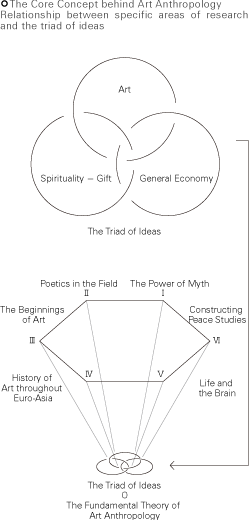
Sample Projects
-
Art and the Wisdom of Nature
The "satoyama" concept as human potential / Art: Corridor between man and nature / Music and the pursuit of spirituality -
Putting the field museum concept into practice
Poetics in the Field -
The "Kegon Philosophy Project" an investigation of logical structures linking life and the brain
Study of Kegon philosophy / Study of the Minakata mandala / Exploring the notes of Suzuki Daisetsu -
Seeking the origins of art in primal art
Art beyond art history -
Constructing Peace Studies
The gift economy resurgent: Visions for peace in the Pacific Rim -
Long-term projects
The Sundaland project / The islands project
Main Events Held to Date
-
Public lectures
"Path over the Seas Revisited: An Archeological Viewpoint"
Lecture by Oda Shizuo (archeologist) -
Dance performance
"King of Spirits"
Starring Mori Shigeya (dancer / Professor, Tohoku Culture Research Center, Tohoku University of Art and Design); with a talk by Mori Shigeya and Nakazawa Shinichi (anthropologist / Professor, Tama Art University, and Director, Institute for Art Anthropology)
-
Lecture and symposium
"Ishida Eiichiro's Dream"
Symposium commemorating the Institute's opening
Panelists: Yoshida Teigo (Professor Emeritus, University of Tokyo), Komatsu Kazuhiko (Professor, International Research Center for Japanese Studies), Nakazawa Shinichi, Tsuruoka Mayumi (historian of art and civilization and expert in Celtic art / Professor, Tama Art University, and Researcher, Institute for Art Anthropology)
"Masaoka Shiki and the Sketcher's Mindset: Where Poetry and Picture Overlap"
Panelists: Okai Takashi (poet), Nakazawa Shinichi, Ozawa Minoru (haiku poet), Matsui Takako (expert in comparative literature and haiku poet / Associate Professor, Utsunomiya University), Hiraide Takashi (poet / Professor, Tama Art University, and Researcher at the Institute for Art Anthropology)
"An Evening at the Shiki Hermitage"
Poetry reading and lecture by Furui Yoshikichi (author) -
Cultural Studies for the Twenty-first Century series
"Yotsuya Shimon on Dolls"
Lecture by Yotsuya Shimon (doll-maker)
"How I've Painted What I've Painted"
Lecture by Yokoo Tadanori (artist / Guest Professor, Graduate School, Tama Art University)
"Depicting Music"
Lecture by Yamamoto Yoko (copperplate artist) and Tsuruoka Mayumi
"Wafted on Celtic Winds"
Lecture by Tsujii Takashi (poet and author) and Tsuruoka Mayumi
"Art, Architecture, and the City"
Lecture by Sejima Kazuyo (architect / Guest Professor, Tama Art University) and Hasegawa Yuko (Professor, Tama Art University, and Researcher, Institute for Art Anthropology)
"For Music Just Beginning"
Lecture by Hosono Haruomi (musician) and Nakazawa Shinichi