Industry-University-Government Collaborative Projects
The Course of Industry,
University and Government Collaborative Research
In their efforts to explore new markets, business enterprises place great hopes on the capabilities of students who will lead the values of the next generation. Collaborative projects help prepare students for their professional careers by providing valuable opportunities for realizing a project and investigating the responses of end users.
This kind of cooperation with regional organizations and commercial businesses has continued to strengthen TAU's contribution to society and is actively supported by all departments of the university. By producing works directly relevant to society, students can take advantage of opportunities not always offered by a regular university education.
Initially, collaborative research projects were instigated by TAU with the aim of improving education. However, as a result of the considerable success of cooperative activities in recent years, an increasing number of projects are now initiated by other parties, including companies in foreign countries.
With more than twenty years of experience in collaborative research, the university possesses the expertise to plan and execute projects efficiently and effectively. In addition, the research has helped to develop a dynamic educational system in which TAU departments work together to devise inter-disciplinary courses. This real-world element in the curriculum has attracted a great deal of attention from various quarters. Besides cooperating with leading companies, the university now works with municipalities and medical corporations on themes connected to health and welfare, thus expanding the connections between art and society.
Industry-University-Government Collaborative Research and PBL
The Ministry of Education, Culture, Sports, Science and Technology (MEXT) invites submissions from universities for new approaches to university education and assists and subsidizes selected programs. In 2005, TAU programs received "Distinctive University Education Support Program" and "Program Responding to the Needs of Modern Education" awards from MEXT. This recognition confirms the continuing dedication of Tama Art University to excellence in art and design education, a constant feature of its activities since its establishment in 1935. TAU thus preserves the tradition established by Hisui Sugiura, the first president of the university, who advocated the notion of "commercial art" and introduced it into university education.
A curriculum which includes collaborative research undertaken with industry, academia and government organizations undoubtedly motivates students to learn and attain great educational achievements. In order for all students to participate in this approach, TAU introduced PBL (project based learning) subjects into its curriculum in 2006 in advance of other art universities. PBL is a new type of class system which promotes research projects as part of class activities. This idea was first introduced in universities in North America twenty years ago, when TAU was already including actual research projects in its curriculum. Since Japanese educational institutes are now very keen to put this method into practice, it is said that the university pioneered this trend in Japan.
Details and prospects of industry-university-government
collaborative research
Joint projects involving TAU are categorized into three types.
-
Practice
Research is carried out on a particular theme, with the aim of producing a commercially viable article. Designs created by students appear on the market as merchandise and may involve registration of a design and application for a patent. -
Future Design
Research projects look into new types of products and markets by anticipating the future needs of society rather than trying to put something into immediate practice. -
Suggestion
Research projects are undertaken together with local industries and exponents of traditional arts and crafts in order to contribute to the development of local industries and the revitalization of regional economies.
The focal point of this variety of collaborative projects is the Research Center, where the staff use state-of-the-art information technology to coordinate their activities. In addition, the center produces exhibitions and digital archives of final results, while promoting joint works and events among all departments, joint research among faculty, and joint projects with other universities.
Project Examples
Renai Blanche
Artwork Project for Renai Blanche Yokohama Kaigan Dori (Yokohama Coast Road)
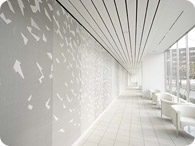
The Renai Blanche mansion-style apartment building is nestled among historic buildings on the scenic Yokohama coastal road. The artwork design project is featured on the great wall in the ground floor entrance lounge. The project took the form of a competition over 18 months, involving selection of designs and materials and consideration of issues such as placement and positioning. The basic concept was to create a design that changes from day to night, with a direct appeal to both residents and passing pedestrian traffic. The unique artwork blends well with the apartment building and gives it a new lease of life.
Contract research from 2004-2005
Client: Sohgoh Real Estate Co., Ltd, Sakakura Associates architects and engineers
Entrusted department: Department of Product and Textile Design, Textile Design Course
Exciting Fun Stuff of the Future in 2015 :
Research Regarding Moveable Products for the Near Future
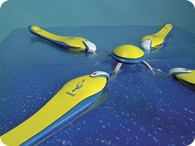
In cooperation with a car manufacturer, students made suggestions on future lifestyles in the four-month project. With the theme of "Exciting goods 2015", the third-year students of the Product Design Course designed innovative sports and mobility products for people of all ages, benefitting from advice from expert designers of two-, four-wheeled and all-purpose vehicles from Honda Motor Corporation.
Contract research
Client: Honda R & D Co., Ltd.
Entrusted department: Department of Product and Textile Design, Product Design Course
Edogawa Project :
Industry, Academia and Public Institute Project on the Traditional Crafts of Edogawa Ward
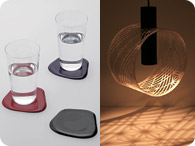
This project has been conducted annually from 2003 with the aim of promoting local industry through exploring the potential of traditional handicrafts. In conjunction with Joshibi University of Art and Design and Tokyo Zokei University, TAU makes new creations, working together with traditional craftsmen. The resulting work is evaluated in terms of suitability for commercial production.
Contract research from 2003-2005
Client: Edogawa City Office Industrial administration improvement division
Entrusted departments: Department of Architecture and Environmental Design, Department of Product and Textile Design (Product Design Course and Textile Design Course), Department of Information Design, Department of Ceramic, Glass, and Metal Works, Department of Sculpture and Department of Design
Collaborators: Artisans of traditional crafts living in Edogawa Ward
Deli °F Project : Project for Producing a New Style of Store

TAU received the commission from a supermarket operator to produce a new style of 24-hour store. The chain mainly sells everyday foodstuffs, targeting working women.
Design work included the store name, logo, brand identity design, interior and exterior design, shop sign, POP design, uniform, package design and advertising. The first "°Deli °F" store opened in Hiratsuka City, Kanagawa Prefecture in December 2003 and the second in Chiyoda Ward, Tokyo in December 2005. The project was awarded a Good Design Award New Frontier Design Category in 2004.
Contract research in 2002
Client: Fuji Citio
Entrusted departments: Department of Architecture and Environmental Design, Department of Graphic Design, Department of Product and Textile Design, Textile Design Course